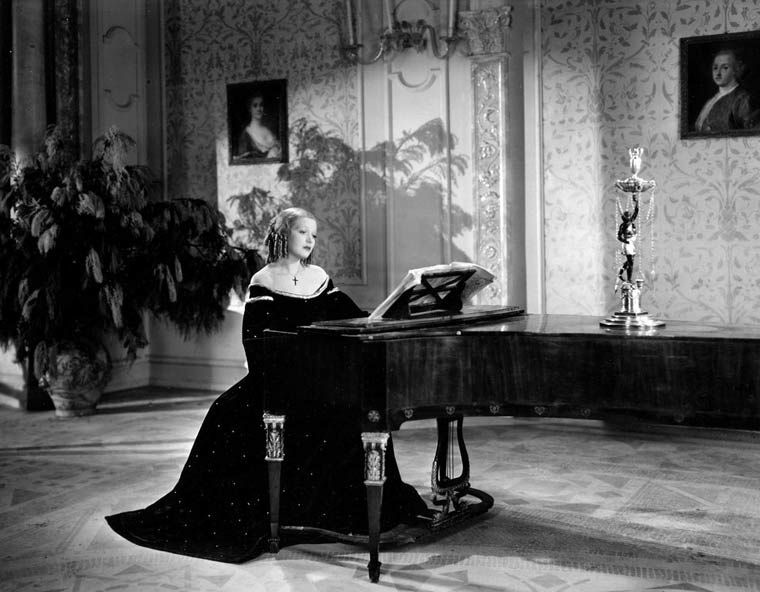
The Life of Marta Eggerth
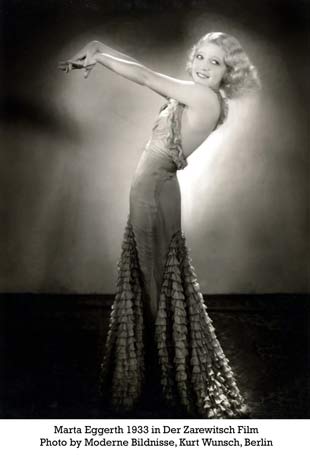 Marta Eggerth was truly one of the last survivors of the "The Silver Age of Operetta". Many of the 20th century's most famous composers including Franz Lehár, Fritz Kreisler, Robert Stolz, Oscar Straus, Hans May, Franz Grothe and Paul Abraham composed works especially for her. After a celebrated stage and film career since her early teenage years, Marta Eggerth remained active, singing right up until the age
of 95, with more than 80 years on stage.
Marta Eggerth was truly one of the last survivors of the "The Silver Age of Operetta". Many of the 20th century's most famous composers including Franz Lehár, Fritz Kreisler, Robert Stolz, Oscar Straus, Hans May, Franz Grothe and Paul Abraham composed works especially for her. After a celebrated stage and film career since her early teenage years, Marta Eggerth remained active, singing right up until the age
of 95, with more than 80 years on stage.
Born in Budapest in 1912, she began singing during her early childhood. Her mother, a dramatic coloratura, dedicated herself to her daughter, who became a pupil of Erzsi Gervay, a famous Hungarian singer and teacher. Already termed a "Wunderkind" at the age of 11, Marta made her theatrical debut in the operetta Mannequins. It was during this time and the years that followed that she began singing the most demanding coloratura repertoire, including Rossini, Meyerbeer, Offenbach and Johann Strauss II.
Marta embarked on a major tour of Denmark, Holland and Sweden while still a teenager, before arriving in Vienna at the invitation of Emmerich Kálmán to understudy Adele Kern, the famous coloratura from the Vienna State Opera, in Kálmán's operetta Das Veilchen vom Montmartre (The Violet of Montmartre). She would eventually take over the title role to great critical acclaim after Miss Kern suddenly became indisposed. Following this, she performed the role of Adele in Max Reinhardt's famous 1929 Hamburg production of Die Fledermaus at the age of 17, perhaps the youngest ever to undertake the part.
It was during the early 1930s, however, that Marta Eggerth was discovered by the film industry, and her career took off resulting in international fame. Marta Eggerth made over thirty films in four languages (English, German, French and Italian). Among the highlights were, Die Czardasfürstin, Das Hofkonzert, Die blonde Carmen, Ein Lied, ein Kuss, ein Mädel, Casta Diva (the story of Bellini), The Unfinished Symphony (the story of Schubert), Zauber der Bohème (with Jan Kiepura) and Valse Brilliante. These films were international productions, made in several languages in Austria, Germany, France, Italy and England. Two of them, Es war einmal ein Walzer (1932) and Die ganze Welt dreht sich um Liebe (1935) were especially written for her by Franz Lehár. It was on the set of the 1934 film Mein Herz ruft nach dir (My Heart is Calling You) that she met and fell in love with the dashing young Polish tenor, Jan Kiepura. They were married in 1936. Together, they became known as Europe's "Liebespaar" (Love Pair) causing a sensation wherever they appeared.
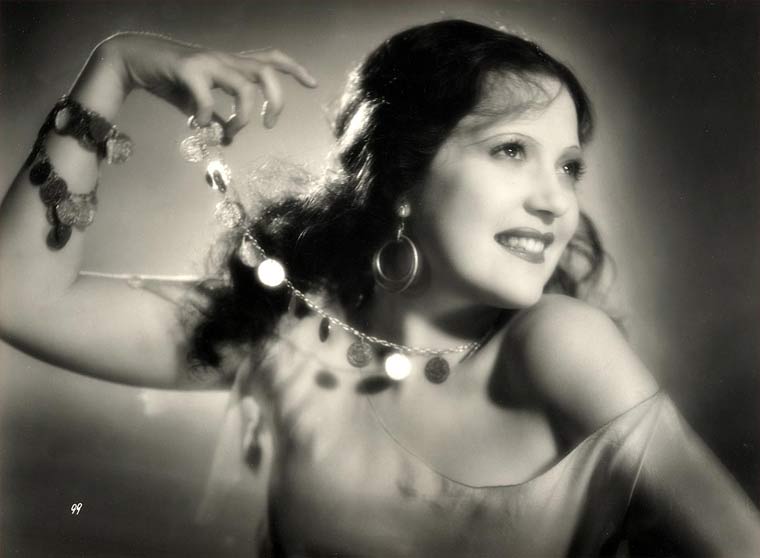
Kiepura was also one of the first international superstar tenors to reach the vast public through the motion picture medium. He was handsome, slim and charismatic - an ideal combination for the screen. His simultaneous meteoric rise as both an Opera and Movie Star is, until today, a unique achievement. Some of his major films included Tell Me Tonight, My Song for You, Im Sonnenschein, Zauber der Bohème and My Heart is Calling You (these two with Marta Eggerth), were all made during the 1930s.
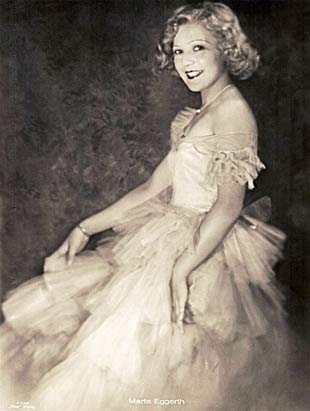 On February 10, 1938 Kiepura made his debut at the Metropolitan Opera, in New York, as Rodolfo in La Bohème and went on to sing leading tenor roles in Tosca, Rigoletto, Carmen, Manon and Aida as well as singing up to 80 concerts a year throughout the USA and Canada. While Kiepura toured the USA, Marta Eggerth was signed by the Shubert Theatre on Broadway to appear in Richard Rodgers' musical Higher and Higher. She subsequently signed a contract with Metro-Goldwyn-Mayer in Hollywood, and made two movies with Judy Garland For Me and My Gal and Presenting Lily Mars during the early 1940s.
It was the Kiepura and Eggerth love story, however, which would endure and so thrill audiences. As a singing team, they were perfectly matched. In Chicago they had already performed together on the operatic stage in La Bohème, to rave reviews. Their joint success was now unstoppable.
In 1943 they starred in a revised production of Lehár's The Merry Widow by the New Opera Company, at Broadway's Majestic Theatre, with Robert Stolz conducting and George Balanchine as choreographer. It was a huge success, which they would eventually perform over 2000 times all over America and Europe - in five languages! Marta Eggerth would become perhaps the most famous Hanna Glawari ("Widow") of all time. After World War II they returned to France touring and making films, such as La Valse Brilliante (1948) and then The Land of Smiles (1952) before bringing The Merry Widow to London's Palace Theatre in 1954.
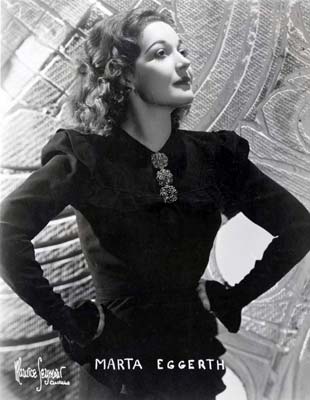 Throughout her career, Marta Eggerth maintained active recital tours in Europe, Canada and the USA combining her extensive repertoire in Lieder, opera, film songs and especially Viennese operetta. Jan Kiepura's equally active recital schedule often meant that the couple would be temporarily separated. But the couple's international tours often brought them together to the same city, where they would perform to delighted crowds. In London, they gave two sold out concerts in one week at the Royal Albert Hall in 1956. The singing couple continued throughout the 1950s and early 1960s with more productions of The Merry Widow in the U.S., concerts and other operetta productions in Europe. Then in 1965, they brought The Merry Widow back to Berlin for yet another successful run.
For several years after Jan Kiepura's premature death in 1966 in New York, Marta Eggerth did not sing. Finally, persuaded by her mother, who had never left her side throughout her life, she decided to revive her career, and until today, she has carried on. In addition to European concerts, she began to make regular television appearances in the 1970s. In 1984 Marta Eggerth returned to the American stage to co-star in the Tom Jones and Harvey Schmidt musical Colette opposite Diana Rigg in Seattle and Denver, and later in Follies by Stephen Sondheim in Pittsburgh.
In 1999, at age 87, she sang on the stage of the Vienna State Opera in a special televised matinee concert hosted by the late opera impresario and historian Professor Marcel Prawy, to mark that Opera house's first production of Lehár's The Merry Widow. She sang a medley from The Merry Widow in four languages and received a spontaneous standing ovation (rare at the Vienna State Opera). She repeated this in 2000 at a gala performance to mark the 200th anniversary of Vienna's Theater an der Wien, hosted once again by Professor Prawy. Both of these events were highly acclaimed.
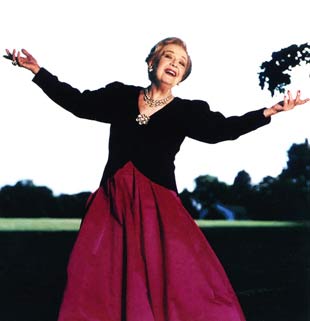
"My Life My Song", released in March 2005 by Patria Productions, highlights more than 70 years of her recordings from the early 1930s to 2002.
Read more about Marta and her recordings →
Marta Eggerth was even seen in a popular television detective series in Austria called Tatort playing the role of an ageing diva, suspected in a murder case - but innocent, of course!
In 2001 at age 89, Eggerth returned to London for a concert at Wigmore Hall in an Interview-in-Concert, hosted by British author and critic, Brendan Carroll. She also sings at the annual Licia Albanese/Puccini Foundation Gala Concerts at Lincoln Center's Alice Tully Hall in New York, to much fanfare. Highlights of 2006 concerts and lectures include a Master Class at the Manhattan School of Music in New York on the operetta genre, two concerts at the Metropolitan Museum of Art coming up in April and today's very special concert and discussion at New York University's Osher Lifelong Learning Institute (OLLI).
Marta Eggerth was awarded many major artistic decorations from Austria, Germany, Poland, and Italy in recognition of her accomplishments in operetta, theatre and film. On May 9, 2006, Mme Eggerth received the Distinguished Achievement Award from the Schuyler Foundation for Career Bridges at a Gala in New York.
In 2006, Marta Eggerth appeared twice in a Recital/Lecture at the Metropolitan Museum of Art in Manhattan. A highlight of that year was a Cabaret Show at the Cafe Sabarsky at the Neue Gallerie in Manhattan, where she has entertained and thrilled audiences with her vivacity, glamour and the great pre-war Viennese/Berlin cabaret style of wit, artistry and song.
Marta Eggerth always retained the cultural richness of an era past, while always encouraging young artists to be the best they could be. She stayed young in voice and in spirit until the age of 100 and always thrilled her audiences with her charm and grace. She was on stage in Theater, Opera and Operetta for 90 years.
Marta passed away on December 26th 2013 in Rye New York, but her legacy is alive and well and her artistry continues to be celebrated and treasured worldwide.
Marta Eggerth: My Life My Song